






Skip links

KOLOR TB™ is a comprehensive MATLAB® based toolbox that integrates 18 advanced toolsets spanning the full spectrum of color science—from spectral measurement and colorimetric transformations to optical modeling, vision simulation, color appearance modeling and Uncertainity analysis.

Designed for scientists, engineers & technologists, artists & designers, researchers & academia, KOLOR TB™ bridges rigorous scientific models with practical, real-world color workflows and applications. Its modular, extensible design supports high-performance computation, batch processing, and seamless integration into research and industrial color workflows.

Below are the toolsets of KOLO

KOLOR TB™ enables professionals to move beyond isolated formulas and fragmented tools, offering a holistic environment where color can be measured, modeled, simulated, and understood. From lighting and materials to imaging, displays, design, and visual perception, the toolbox empowers users to explore how color behaves—not only numerically, but perceptually—under real-world conditions. By bridging scientific rigor with practical insight, KOLORware helps transform color from a challenge into a creative and analytical advantage.

TOOLSET OVERVIEW

SRD PROCESSING
SRD PROCESSING

  1. Spectral Filtering.
  2. Bandpass Correction/deconvolution.
  3. Interpolation/Extrapolation and Up-sampling.
  4. Fourier Transformation.
  5. Principle Component Analysis.
  6. Eigen Vector Analysis.
  7. Matrix R Decomposition.
  8. Discrete Derivatives.
TRI-STIMULUS VALUES
TRI-STIMULUS VALUES

  1. Computation of Tri-Stimulus Values in accordance with ASTM and CIE standards.
  2. Computation of ndim values.
  3. CIE and Munsell value.
  4. Cylindrical and Spherical Transformations.
  5. SRF recovery Algorithms.
  6. Algorithms for the Computation of ASTM Table-Of-Weights.
CHROMATICIY SCALE
CHROMATICIY SCALE

  1. CIE xy, uv and uv
  2. CIE xy to Hunt and MacAdam chromaticity.
  3. CIE XYZ to chromaticity.
  4. Polar and Psychological Parameter Transformations.
  5. Computations of Various Colorimetric Quantities.
  6. Inquire Chromaticity Diagram related queries.
COLOR SPACE
COLOR SPACE

  1. CIE XYZ to various important color spaces viz. L*a*b*, L*u*v*, IPT, Ljg etc. transformations.
  2. CIE XYZ to chromaticity-related spaces viz. xyY, uvY, uv
  3. CIE XYZ to various RGB color spaces.
  4. Set Data Types of RGB, XYZ and L*a*b*.
  5. Miscellaneous Color Spaces viz. HVC, HRU etc.
COLOR NOTATION
COLOR NOTATION

  1. Psychophysical Notation and Conversion Algorithms.
  2. Munsell to ISCC-NBS.
  3. Munsell to CIE xyY and vice versa.
  4. Coloroid to CIE xyY and vice versa.
  5. ColorCurve to CIE XYZ and vice versa.
  6. More in progress…
CHROMATIC ADAPTATION TRANSFORMATION

  1. CIE and Miscellaneous Chromatic Adaptation Models [CAT].
  2. CIE Models: 2006, 2002 and 1994.
  3. CMC Models: 1997 and 2000.
  4. Von Kries transformation and General VK Model.
  5. Simple Models: Wassef, MacAdam, Sobagaki etc.
  6. Toolkit to develop and validate new CAT Models.
COLOR APPEARANCE MODEL

  1. CIE and Miscellaneous Color Appearance Models [CAM].
  2. CAM Viewing Parameters.
  3. CIE Models: 2016, 2002 and 1997.
  4. RLab, LLAB and ZLab models.
  5. Hunt, Fairchild and Nayatani Models.
  6. CAM operate in various modes viz. cam, cat and color space.
  7. Toolkit to develop and validate custom algorithms.
COLOR DIFFERENCE
COLOR DIFFERENCE

  1. Color Difference [∆E] formulae that work in different color spaces and in various modes.
  2. CIE2000, CIE1994, CMC(l:c), Bradford and Leeds formulae.
  3. OSA Ljg formulae versions and various computational modes.
  4. Performance Indices such as stress index, gamma and performance factors.
  5. Toolkit to develop new ∆E formulae.
COLOR QUALITY
COLOR QUALITY

  1. A range of metrics to characterise quality of light sources.
  2. Indices include color constancy, flattering, preference, color quality scale and CIE and IES standards.
  3. Color Temperature (Tc) methods: Roberts, Ohno, Walter etc.
  4. Tc to CIE uv and Distribution Temperature conversions (Td).
  5. Tolerance Ellipse.
COLOR VISION
COLOR VISION

  1. ATD Color Vision Model.
  2. CIE LMS Cone Fundamentals and PO2006.
  3. CIE Vλ, Lens Tλ, Macular and Lens optical density functions.
  4. CIE Blue Light and Light response to IPRGCs.
  5. LMS to XYZ, DKL and Lrb conversions.
  6. Spectral Reflectance to LMS conversion.
COLOR UNCERTAINITY
COLOR UNCERTAINITY

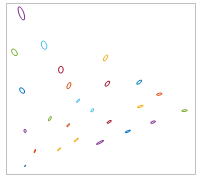
  1. Generation of random color stimuli from normal and uniform distributions.
  2. Uniform CIE xy chromaticity points.
  3. Statistical Metrics such as mean, standard & mean deviations etc.
  4. Principle Component & Eigen analysis.
  5. Jacobian Matrices for optimizations.
OPTIMAL COLOR
OPTIMAL COLOR

  1. Algorithms to compute vertices of OCS in n dimensions.
  2. Transition Wavelengths to Delta and Central-Wavelengths.
  3. Transition Wavelengths to Optimal Reflectance and computation of XYZ.
  4. Computation of MacAdam Limits, MMV etc.
  5. Query on stimuli.
SENSORS & DEVICES
SENSORS & DEVICES

  1. Parameters and Specifications of a range of RGB color spaces.
  2. RGB CODEC functions.
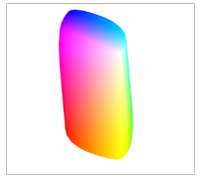
  3. Generate RGB color gamuts and slices.
  4. RGB to HIS, YIQ, ICtCp transformations.
  5. Demichel NPS.
  6. GOG and YNSN device models
OPTICAL PROPERTIES
OPTICAL PROPERTIES

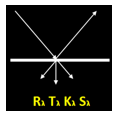
  1. Surface Correction and Fresnel R.
  2. Model to Compute Reflectance from Thin Films.
  3. Reflectance to KS Functions.
  4. Computation of K and S parameters.
  5. Concentration to KS function using Duncan principle.
  6. Miscellaneous functions to develop, simulate and test colorant recipe formulations.
ACHROMATICS
ACHROMATICS

  1. Whiteness, Yellowness and Gray Scale Grading.
  2. CIE and Uchida functions to compute Whiteness Index.
  3. Yellowness in accordance with CIE and ASTM standards.
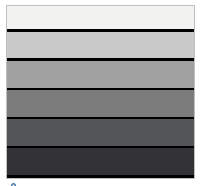
  4. Gray Scale Grades for color-change and staining using a range of methods.
  5. Generate WI loci.
SOURCES
SOURCES

  1. Generate SPD of Planckian, CIE D series illuminants.
  2. ASTM weights for various illuminat-observer combinations.
  3. CIE Whitepoints, Color Matching Functions and chromaticity tables.
  4. Matrix R decomposition of input.
  5. Set units of Spectral Power Distribution [SPD].
GRAPHICS
GRAPHICS

  1. Draw xy, uv and uv Chromaticity Diagrams, plot chromaticity points etc.
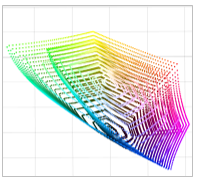
  2. Draw Color Gamuts in various color spaces and plot points.
  3. Generate and plot Tolerances on color difference tuples in L*a*b*.
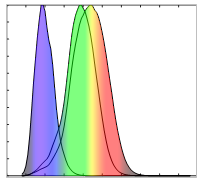
  4. Put Intensity and Spectrum bars and fill spectra.
  5. Visualize Macbeth classic chart.
UNITS
UNITS

  1. Get optical constants.
  2. Transform radiometric quantities to luminous and quantal.
  3. Transform with angular units.
  4. Transform within luminous quantities.
SRD PROCESSING
TRI-STIMULUS VALUES
CHROMATICITY SCALE
COLOR SPACE
COLOR NOTATION
COLOR DIFFERENCE
CHROMATIC ADAPTATION
COLOR APPEARANCE MODEL
COLOR QUALITY
COLOR VISION
COLOR UNCERTAINTY
OPTIMAL COLOR
SENSORS & DEVICES
OPTICAL PROPERTIES
ACHROMATICS
SOURCES
GRAPHICS
UNITS
×
This website uses cookies to improve your web experience.
Explore
Drag